Research
Earliest Cambrian macroalgae from South China
This project investigates the morphology and preservation of early Cambrian macroalgae, namely Vendotaenia. Clarifying their physical features and how they are fossilised will help improve identification of early algal fossils. Macroalgae are key primary producers that influenced early marine ecosystems, carbon cycling, and oxygenation of the Earth, so refining their fossil record is essential for understanding the evolution of complex life.

Geochemistry of latest Ediacaran burrow complexes, Southwest Mongolia
This study examines some of the earliest vertically penetrative burrowing structures, identified before the Ediacaran–Cambrian boundary. Although these burrows are more complex than earlier forms, geochemical evidence shows they had a limited impact on sediment chemistry. This suggests that major ecosystem and sediment changes occurred later, in the Phanerozoic.
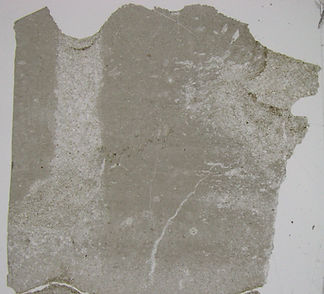

The Ediacaran–Cambrian boundary marks a pivotal transition in Earth’s history. My research demonstrates that spiny microfossils (acritarchs) and bead-like forms correlate with existing boundary proxies, showing that these fossils may be used to bracket this key transition across deposits of South China.
Acanthomorphic acritarchs of the Kheseen Formation, Mongolia
My ongoing Master's work focuses on the earliest Cambrian Kheseen Formation, northern Mongolia. Phosphatic units within this formation contain a diverse assemblage of three-dimensional acanthomorphic acritarchs. I am continuing to work on characterising this assemblage and contextualising these microfossils within the broader Ediacaran-Cambrian transition.

Latest Triassic Rhaetian Bone Bed at Lilstock, Somerset, UK
During this research, I investigated the onset of the Rhaetian Transgression as recorded in deep-water deposits at Lilstock, North Somerset, focusing on microvertebrate faunas. The study highlights the ecological and environmental changes associated with this significant transgressive event during the Late Triassic.
